Magazine
Rolex Daytona: the origins of the myth
Daytona is a name that opens up a whole world of mechanical history and sporting fascination to all enthusiasts. We're talking about one of the few true contemporary legends in watchmaking. Paradoxically, this myth was actually born several years after the production and marketing of the first Rolex Daytona chronograph, in 1963 (ref 6239). But let us proceed in order.
Daytona is a name that to all enthusiasts opens up a whole world of mechanical history and sporting fascination. We're talking about one of the few true contemporary legends in watchmaking. Paradoxically, it is a myth born in reality several years after the production and marketing of the first chronograph Rolex Daytona, in 1963 (ref 6239).
But let's go in order.
The association between the Swiss maison and the very famous Daytona Beach circuit in Florida is almost physiological, since the Oyster (not yet chronographs) of the crowned house were on the wrists of the famous drivers who made motor racing history, competing from the 1930s on Daytona Beach in record-breaking strokes.
The most famous among them, Sir Malcolm Campbell and Sir Henry Seagrave, started a diarchy (which was ended by the tragic death of the latter) that led their cars to break the 300 km/h wall within a few years, reaching 445 km/h in 1935.
The watches on the wrists of these drivers naturally became a symbol of competition and athleticism.
In 1959, the sandy track at Daytona was transformed into a real concrete circuit, and the advertisements in which this racing environment served as the backdrop for Rolex advertisements began.
The winners of the competition received a Rolex as a prize, and - from 1963 - precisely a Rolex Daytona.
Yes, because in that fateful year, the history of the legendary timepiece from the Geneva-based company began, which had already been producing chronographs for some time, but until then had been tied to a resolutely classical conception.
This is the reference 6239, produced for five years. The tachymeter scale typical of chronographs is moved to the outer bezel, leaving the dial freer and more readable, and the graphics focus on the sporty colour contrasts between the light colour of the dial and the black of the counters and vice versa. The movement is a Valjoux hand-wound, Valjoux which, although in different variants, will accompany all Daytona watches until 1988.
In 1965 the new reference 6240 accentuates the Daytona's sportiness, with the black plastic external bezel and the chrono pushers that become screw-down.
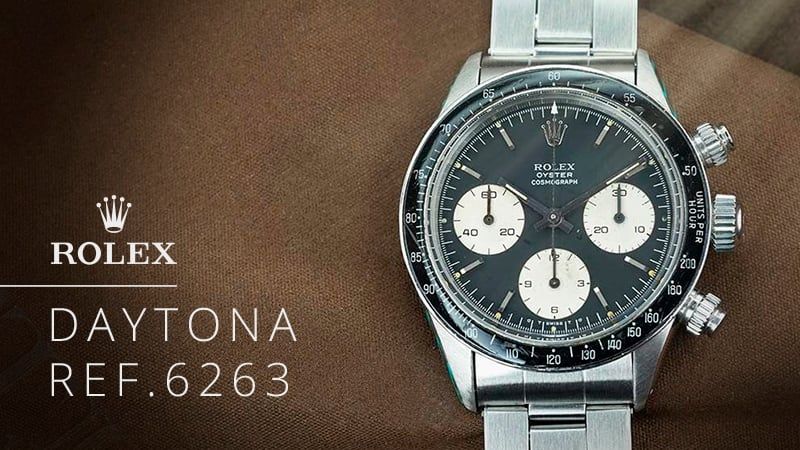
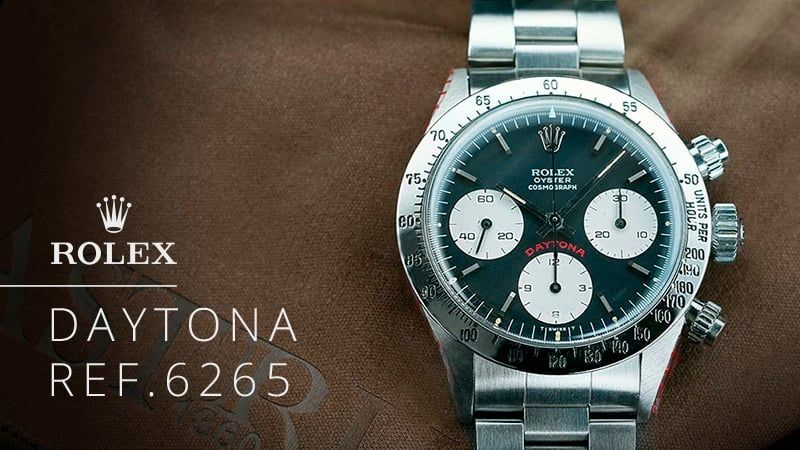
In the references 6263 and 6265 the water-resistance is increased from 50 to 100 metres.
In '69 a film was released, 'Indianapolis hellish track', in which the protagonist Paul Newman wears a Rolex . It is not a Daytona, as is often believed, but the actor in his everyday life - even before the commercials that he will soon be shooting - wears precisely the Daytona in a special dial version, with an internal rehault, and the typical two-tone colouring also present in the circumference of the dial, embossed. A dial that from then on would become the legendary 'Paul Newman'.
New versions followed throughout the 1970s and 1980s, with references 6269 and 6270, and the Daytona inscription finally standing out in red .
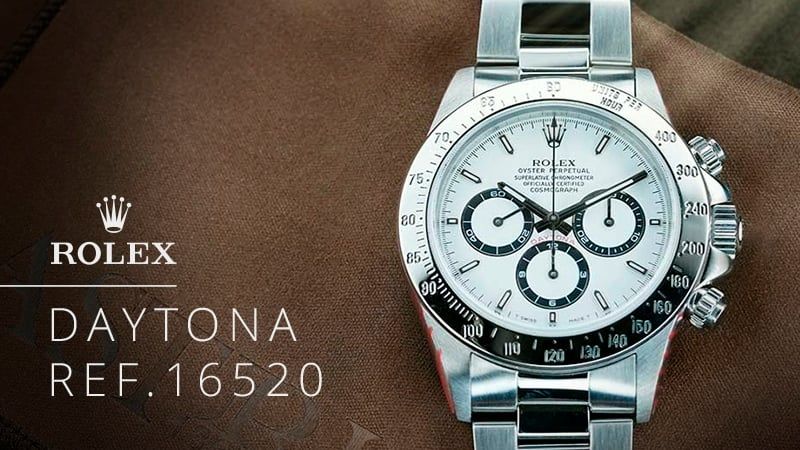
But the turning point, from a commercial point of view, came with the reference 16520, which appeared on the market in 1989.
It was the first automatic Daytona (in steel) with an in-house made calibre (4030) derived from the design of the Zenith El Primero distorted by Rolex design, which lowered its frequency from 31.600 to 28,800 vibrations, changing half of the components.
This was finally the success, from which the retroactive myth of the historical Daytona watches was immediately born, which in just a few years became cult objects, sought after by collectors all over the world and sold at international auctions at staggering prices .
The tachymeter bezel is in steel, as is the bracelet Oyster. The dial is sober, without a date, with the two-tone silver and black dials less evident, traced back to the outer circumference of the counters.
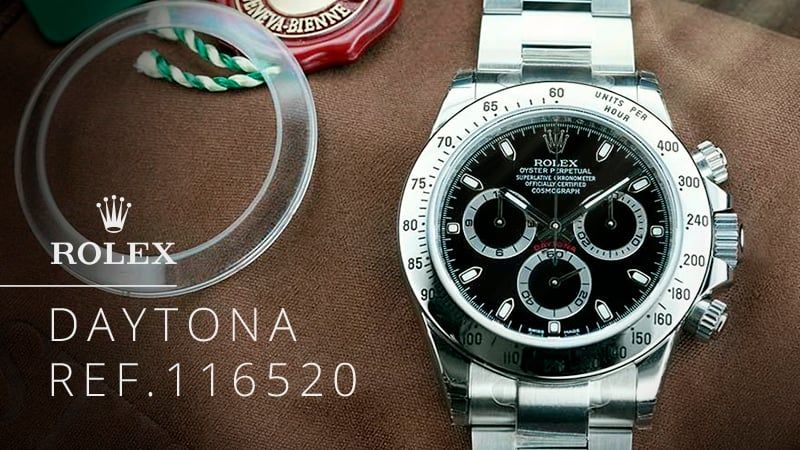
And we come to 2000, with the celebrated reference 116520, which in addition to the aesthetic modifications (repositioning of the pushers, internal rehault, shorter hour markers) presents the real great novelty of first automatic integrated Rolex chronograph calibre one hundred per cent manufacture, on which the paracrhrome balance spring is later mounted.
Over the years, glamorous versions in noble metals and precious stones followed one another, such as the Daytona Leopard or the Rainbow (ref 116515), and in 2013, to celebrate the 50th anniversary of the Myth, a ceramic bezel was mounted on the first Daytona in platinum (ref 116506).
Of course, the steel version remains the most sought-after by enthusiasts, and in 2016 Rolex presents its 'return to the future' with the reference 116500 LN (which replaces the previous one 116520), with the ceramic bezel black, ideally reconnecting with the models that for decades have made enthusiasts dream in the footsteps of the Legend.
SECOND PULSE ASTRUA: DISCOVER OUR SELECTION