Magazine
Girard-Perregaux: the Laureate
Not a few watchmaking myths were born thanks to the suggestive power of the cinema: several iconic timepieces have also become so because they were worn by an actor in a famous film. There is, however, one truly singular case in which this link did not come about thanks to the object that appeared on the protagonist's wrist: we are talking about the legendary Laureato by Girard-Perregaux, a historic Swiss manufacturer that is celebrating its 230th anniversary this year.
Not a few watchmaking myths were born thanks to the suggestive power of the cinema: several iconic timepieces also became so because they were worn by an actor in a famous film.
There is, however, one truly singular case in which this link did not originate thanks to the object that appeared on the protagonist's wrist: we are talking about the legendary Laureato by Girard-Perregaux, a historic Swiss watch manufacturer that is celebrating its 230th anniversary since its foundation.
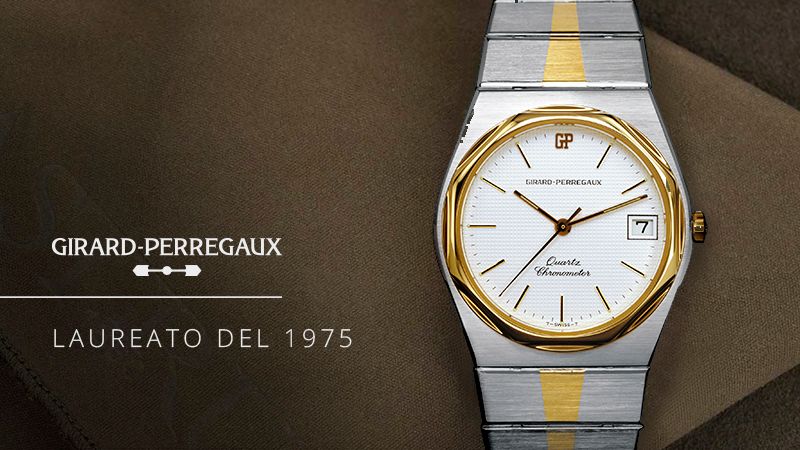
Many people think that the name " Laureato " was born thanks to the famous film of the same name starring Dustin Hoffman , but this is not actually the case: the name derives instead from the certification that this timepiece obtained in the 1970s as one of the first Swiss quartz chronometers: it had obtained its degree. In fact, the Laureato was Girard-Perregaux's response to the challenge of Japanese quartz watchmaking, which at the beginning of the decade had made the Swiss giants tremble, amid widespread - but fortunately later revealed to be unfounded - fears that the new technology, based on electronics, would supplant centuries of mechanical engineering applied to time.The first model is in fact fitted with a quartz calibre developed a few years earlier by the Manufacture .
The lines - which over the years will evolve without ever betraying the original spirit - are inspired by the best of watch design of those years, and it is not difficult to recognise the reference to the style of the great creative designer Gerald Genta.
In the 1980s, the bracelet was enriched with the central 'h' link, a feature that was never abandoned.
It was the 1990s that finally saw the Laureato measure up to mechanical movements, since the manufacture at that time had produced a new, highly prized ultra-flat automatic movement with a rapid date display, which was incorporated into the Laureato as Calibre 8010 but was also successfully adopted by other prestigious Maisons, including Vacheron Costantin.
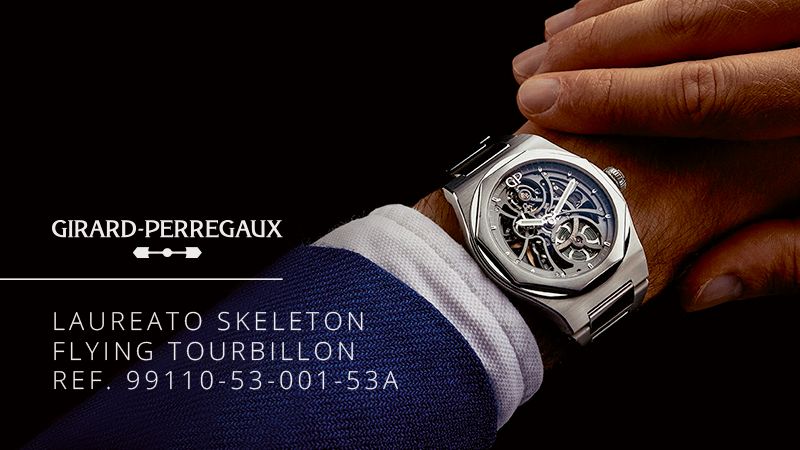
The history of the Laureato, model after model, unfortunately seemed to end in a marvellous swan-song, in 2006, with an absolute masterpiece: we are of course talking about the Tourbillon on three sapphire bridges, an evolution of the very famous movement Girard-Perregaux 'Sous trois Ponts d'or'.
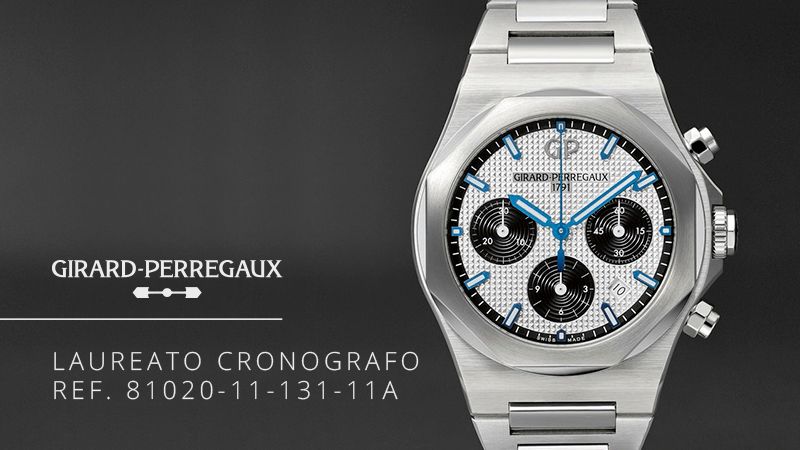
And yet, as we have written, to the great delight of enthusiasts of this beautiful watch, five years ago, the maison of La Chaux-des-Fonds relaunched the Laureato in the world of contemporary watchmaking icons , with a collection that modernises its stylistic cornerstones without betraying its spirit, which has always been marked by a performing simplicity.
Case sizes range from the feminine 34 mm of the quartz manufacture models, to the 38 mm that enclose with a diamond bezel the intense depth of the black onyx dial, to the very elegant 42 mm time-only or chrono models, endowed with an Apollonian grace in each dial colour version.
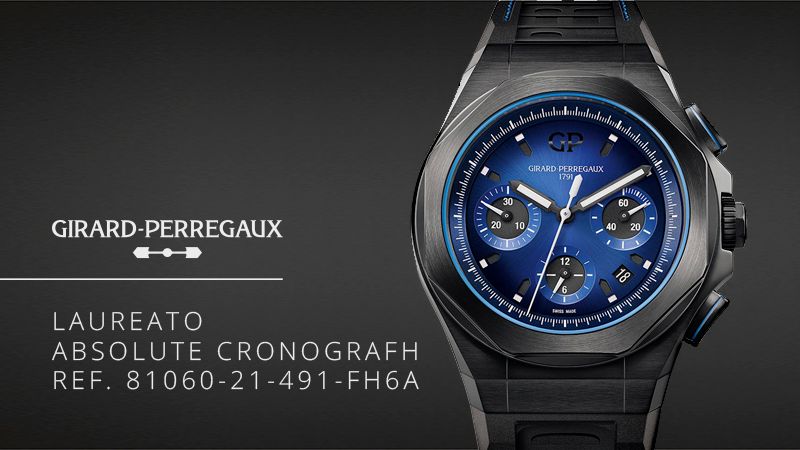
The 'extreme' version of the Laureato, the Absolute model, is available in time only, chrono and hours: a watch of rare grit that does not renounce the sobriety of a monochrome deep blue dial, in a 44 mm titanium case with a technical rubber strap, emphasising the sportiness of a model that triples the 100 m water-resistance rating of the time-only model, bringing it to thirty atmospheres.